Mostrando entradas con la etiqueta madre de dios. Mostrar todas las entradas

jueves, 1 de junio de 2023

EBOOK TÉCNICA DE AMALGACION DE MINERALES AURIFEROS POR GRAVIMETRIA

Nuevo libro electrónico o eBook de Recuperación de Platino, Paladio, Rodio de Catalizadores Catalíticos 
del Ing. HERWARTH MORALES 
disponible ahora en TIENDAS KINDLE DE AMAZON.
Escucha en Spotify:
y soundcloud: 
Escucha Como recuperar Platino, Paladio y Rodio de Catalizadores Automotrices de Herwarth Morales en soundcloud escuchar sobre libro recuperación de platino

Cualquier pregunta o duda escribir al email: herwarth3@gmail.com

ISBN-13: 978-1795591126


AUTOR: ING. QUÍMICO HERWARTH MORALES

Visite directamente con este link:

VISITE TIENDAS KINDLE DE AMAZON CON ESTE ENLACE

LIBRO ELECTRÓNICO O eBOOK EN FORMATO KINDLE
Detalles del Producto 
(Product details)
File Size: 27604 KB
Print Length: 123 pages
Simultaneous Device Usage: Unlimited
Publication Date: January 28, 2019
Sold by: Amazon Digital Services LLC
Language: Spanish
ASIN: B07N7K73XT
Word Wise: Not Enabled
Lending: Not Enabled
Screen Reader: Supported 
Enhanced Typesetting: Enabled 

LIBRO EN TAPA BLANDA O PAPERBACK:
DETALLES DEL PRODUCTO
Product details
* Paperback: 152 pages
* Publisher: Independently published (January 31, 2019)
* Language: Spanish
* ISBN-10: 1795591129
* ISBN-13: 978-1795591126
* Product Dimensions: 6 x 0.4 x 9 inches
* Shipping Weight: 10.1 ounces (View shipping rates and policies)
* Average Customer Review: Be the first to review this item
  DISPONIBLE EN: Amazon Digital Services LLC

Usted ha ingresado al mundo de la metalurgia extractiva que abarca conceptos tan antiguos como la pirometalurgia (fuego), hidrometalurgia (agua) y electroquímica (energía) que en muchos sentidos, es el equivalente moderno de la alquimia al cual pertenecieron distinguidos científicos, como Isaac Newton y Robert Boyle. 
En este manuscrito se dan a conocer los métodos más utilizados para recuperar el platino y los metales del grupo de los platinos (PGMs) a partir de catalizadores o convertidores catalíticos usados o desechados aplicando el método hidrometalúrgico, extracción con disolventes o lixiviación acida.
Se pretende proporcional un método didáctico y práctico de ser posible la ejecución del resultado mucho más pragmático y funcional.
El propósito del manuscrito es dirigirse a toda persona interesada en el reciclaje de PGMs a partir de los convertidores catalíticos, pudiendo ser también de utilidad a aquellos que se dedican al conocimiento o la investigación.
El presente libro consta de 4 capítulos distribuidos así:
En el Capítulo I se realiza el estudio general de los principios básicos sobre los catalizadores que serán la materia prima de la recuperaremos metales preciosos como el platino, paladio y rodio presentes en los monolitos cerámicos.
En el Capítulo II se da una guía básica suficientemente clara y concisa sobre cómo realizar el proceso de apertura del Catalizador o Convertidor Catalítico, extracción, dado que se encuentra de una estructura metálica de acero que fue diseñada para resistir las condiciones extremas a las que es sometida durante su funcionamiento.
En el Capítulo III, trata específicamente del método que se emplea en la recuperación del platino y PGMs presentes en material pretratado como se indica en el Capítulo II, en parte se detalla de manera explícita los procedimientos teóricos y prácticos para aplicar el método de extracción con disolventes o SX. Usted podrá conocer las reacciones químicas que ocurren durante el proceso recuperación.
En el Capítulo IV, es una especie de apéndice que da a conocer algunos principios teóricos que pueden resultar útiles para principiantes o emprendedores.


VISITE TIENDAS KINDLE DE AMAZON CON ESTE ENLACE


ADQUIERA YA
NUEVO EBOOK TÉCNICA DE AMALGACION DE MINERALES AURIFEROS
POR GRAVIMETRIA


Ahora también puede comprar su eBook o libro electrónico de su preferencia:
1.- Reciclaje de ordenadores o computadores (microprocesadores, placas electrónicas, placas telefónicas).
2. Recuperación de platino, paladio y rodio de Catalizadores Catalíticos
3. Aceite esencial de Molle o Pirul.
4.Control de calidad en una planta embotelladora
5.Tratamiento de relaves auríferos entre otros.


 INFORMES:

herwarth5@yahoo.es


lunes, 2 de abril de 2018

Special judiciary on environmental crimes established in Peru


The majority of crimes correspond to illegal mining and illegal logging, two activities that seriously affect the region and that so far in 2018 account for 53 complaints.One of the emblematic cases is related to the regional governor Luis Otsuka Salazar, who has two complaints about illegal mining and negligence in the performance of his duties.Aside from the court in Madre de Dios, experts hope to also see courts in other regions of Peru, including Loreto, Ucayali, Cusco, Piura, Lima and San Martin.

On April 1 the first specialized court on environmental issues was launched in Madre de Dios, Peru. The region currently has the highest number of complaints of environmental crimes in the entire country, Julio César Guzmán Mendoza, the public prosecutor specialized in environmental crimes, told Mongabay.

“As of February 20, 2018, we have 2,983 active environmental complaints in the judicial district of Madre de Dios,” Guzmán explained. “Of the approximately 20,000 cases in all of Peru almost 3,000 correspond to this region.” Complaints to the prosecutor’s office and related investigations include cases from 2009 through February 2018.

Illegal mining is one of the most common environmental crimes in Madre de Dios. Photo by Rhett Butler/Mongabay.

Most of the environmental crimes that occur in the region are related to illegal mining and logging, said Guzmán. But we must also add related crimes such as environmental pollution and deforestation.

Illegal mining and damage to forests

Of the 64 cases presented so far this year, 15 complaints correspond specifically to illegal mining crimes and 38 refer to crimes against forests. The other 11 are linked to illicit trafficking of chemical inputs and use of machinery in illegal mining, environmental pollution, degradation of protected flora and fauna, and illegal trafficking of forest products.

In 2017, of the 491 current cases, 97 are specifically related to illegal mining and 211 for deforestation, that is, 62 percent or 308 of the cases, correspond to these two environmental problems in the region: mining and illegal logging.

Last year, in addition to the aforementioned crimes, there were reports of illegal trafficking of species, partly due to public officials granting illegal rights, among other crimes.

For the prosecutor, one of the emblematic cases of Madre de Dios is linked to the regional governor Luis Otsuka Salazar, who has had a complaint about illegal mining against him since 2013. The complaint is in two courts, the transitory environmental preparatory investigation court of Cusco and the fourth preparatory investigation court specialized in environmental crimes of Madre de Dios.

One of the areas affected by illegal logging is the buffer zone of the Tambopata National Reserve. Photo courtesy of Mininter.

In addition, since 2016 the regional governor has also been investigated for the illegal granting of territorial rights, a process that is already in the fourth preparatory investigation court of Madre de Dios.

In this case, the complaint was based on an audit report from the Office of the Comptroller General of the Republic, which revealed the negligence and non-compliance of its functions as a regional authority.

As for other emblematic cases, although all are important for the prosecutor, he highlighted those related to illegal mining in the sector called La Pampa or those of the native Tres Islas community.

Entrapment in environmental justice

Public prosecutor Guzmán considers that the problem of environmental injustice in Peru can be clearly observed in Madre de Dios, where there is a conflict between the excessive burden of processes and the few assignments of prosecutors and attorneys to deal with them.

“Although this new environmental court is a step forward, the problem of the justice system in Peru will not be solved by appointing a new judge or opening a new court,” Guzmán said.

He also explained that the problem is not judicial, instead, it is due to the high burden to which prosecutors and attorneys are subject to, which leads to deficiencies in the investigations. “When there are deficient investigations, the judges are forced to release the defendants. And why does this happen? Because of a large amount of procedural burden which prevents further investigations.”

Deforestation affects forest concessions in Madre de Dios. Owners must deal with illegal logging. Photo by Jack Lo Lau/Mongabay.

In this regard, he mentioned that the office of the Specialized Attorney for Environmental Crimes of the Ministry of the Environment, which he directs, has a staff of eight lawyers for the 20,000 complaints that exist throughout Peru, including the 3,000 in Madre de Dios.

In an interview with Mongabay, the president of the Superior Court of Justice of Madre de Dios, Kori Paulet Silva, said that currently there are only 200 cases prosecuted in Madre de Dios and that these are in the preparatory investigation stage in charge of the magistrates who work in the region.

“Most of the complaints are still under investigation in the prosecutor’s offices specialized in environmental matters and these have not yet been prosecuted, so we have a low number of cases admitted to the Judiciary,” Paulet Silva explained, reaffirming that the entrapment is presented in the investigation stage, as he says, because in many cases the perpetrators of the crime are not identified, since these occur in remote fields and forests of the region. “If they don’t find the ones responsible for the crimes, and if the investigation does not move forward, then it does not advance towards its judicialization.”

Paulet Silva indicated that the criminal activity against the environment is alarming in the region and that most of the cases are related to illegal mining, the same that drags other environmental crimes. “The immense wealth of Madre de Dios, which should be the engine for its development is, unfortunately, the entrance for underdevelopment,” he said.

The new environmental court

Paulet Silva said he has some doubts about the new Specialized Court on Environmental Matters, including that the rule does not specify whether a judge will be in charge of a preparatory investigation or a judge for trial. The difference is that the first one is in charge of resolving the accusation requirements of the prosecutors, that is, reviewing the files and approving them so that they can enter the trial. The second one carries the judgments that lead to sanctions.

Illegal and informal mining has already deforested more than 2,500 hectares of forest in Madre de Dios and pollutes the rivers with mercury. Photo: SPDA.

The resolution of the Judicial Branch published on Jan. 24 in the newspaper El Peruano, states that, “The aforesaid court will have criminal, administrative litigation and constitutional environmental jurisdiction.”

Paulet Silva indicated that he has already made the corresponding consultation with the executive directorate of the judiciary and is now awaiting a response. However, he said that this case could use a magistrate dedicated to applying the sanctions since Madre de Dios already has a preparatory investigation office that looks at environmental issues.

A comprehensive vision of justice in Peru

Alicia Abanto, assistant director for the Environment, Public Services and Indigenous Peoples at the Ombudsman’s Office, said that the creation of the new court is an appropriate measure adopted by the judiciary, especially in the region most affected by illegal mining.

MMAP satellite images show deforestation in La Pampa, in Madre de Dios. Image via MAAP/Planet.
However, she reflected on the complexity and role of other institutions that should contribute so that a judge can have all the elements to properly sanction the environmental crime.

“The prosecution of crime and punishment is not only a function of the judge but also a task of the public ministry, prosecutors, police and other government agencies such as the Ministry of Energy and Mining or the Ministry of Agriculture and Irrigation, to mention some related to environmental issues,” Abanto said.

In relation to the overburdening of the Environmental Prosecutor’s Office, Abanto said that it would be convenient for the government to strengthen it with more resources and that also other prosecutors — Energy and Mining, of Agriculture, of Health — should be involved in the defense of the environment. “The protection of the environment is not only the responsibility of the Ministry of the Environment but of multiple sectors,” she said.

Jean Pierre Araujo, lawyer of the forestry program of the Peruvian Society for Environmental Law (also known by its Spanish acronym SPDA), considered that the decision of the Judicial Power is in addition to the decision made by the Peruvian government in 2008, when the Specialized Attorney’s Offices for the Environment were created (also known by its acronym in Spanish, FEMA). “At that time we saw how there was an explosion of environmental complaints,” he explained.

The expert of the SPDA stressed that this is a reform that follows from the Strategic Plan of the Environmental System of the Judiciary, approved in 2017 and in force until 2021. “It is a policy document that justifies these changes and allows the Judiciary, progressively, to improve the standards of knowledge and specialization in environmental matters.”

However, he said that the courts for environmental crimes should also be established in other regions such as Loreto, Ucayali, Cusco, Piura, Lima and San Martin, among others. “The Strategic Plan includes nine priority regions for the establishment of environmental courts, but this year only one will be launched,” he explained.

For his part, Mariano Castro Sánchez-Moreno, former vice minister of environmental management of the Ministry of Environment and ow a professor at the law school of the Catholic University of Peru, believes that the actions of the justice system in Peru have some gaps that must be overcome, such as the specialization.

The former vice minister said that the treatment of environmental issues, “requires a sensitive management to what is happening.”

“In addition, a knowledge of the legal matter to be treated in all its complexity,” he said. “Decisions should be taken considering the particularities that criminal environmental issues have.”

He agreed with the other experts that the justice system, in general, should be strengthened. “The remediation and environmental rehabilitation are part of the system. The activity that has environmental prosecutors, the police and the Directorate General of Captaincies and Coast Guard, which is responsible for monitoring the rivers must have the right elements to perform their work in the right conditions,” concluded the expert.

Banner image: La Pampa is another area destroyed by illegal mining in Madre de Dios. Photo courtesy of the Peruvian Society for Environmental Law.

viernes, 21 de abril de 2017

Autorizan ingreso de las FF.AA. a Madre de Dios para luchar contra minería ilegal

Por la Resolución Suprema suscrita por los ministros del Interior, Carlos Basombrío y de Defensa, Jorge Nieto, el Gobierno Central autorizó el ingreso de las Fuerzas Armadas (FF.AA) a la región de Madre de Dios para apoyar a la Policía Nacional en su lucha contra la minería ilegal.

La autorización busca que las fuerzas militares brinden apoyo a los efectivos policiales frente a las movilizaciones que los mineros ilegales han anunciado para los próximos días. El permiso será por 30 días desde hoy viernes 21 de abril.

En la resolución se explica que en todo momento será la Policía Nacional la responsable de mantener el control del orden interno en Madre de Dios, agregando que la presencia de las FF.AA. será solo de apoyo.

“La actuación de las FF.AA. estará dirigida a contribuir y garantizar la plena vigencia del derecho a la libertad y seguridad personales, a la libertad de tránsito por las vías y carreteras (…), facilitando de este modo que los efectivos de la Policía Nacional concentren su accionar en el control del orden público”, señala la resolución publicada en El Peruano

sábado, 19 de noviembre de 2016

Leaked map reveals chronic mercury epidemic in Peru

Leaked map reveals chronic mercury epidemic in Peru

People living upriver from gold-mining are the most contaminated, according to US-based scientists

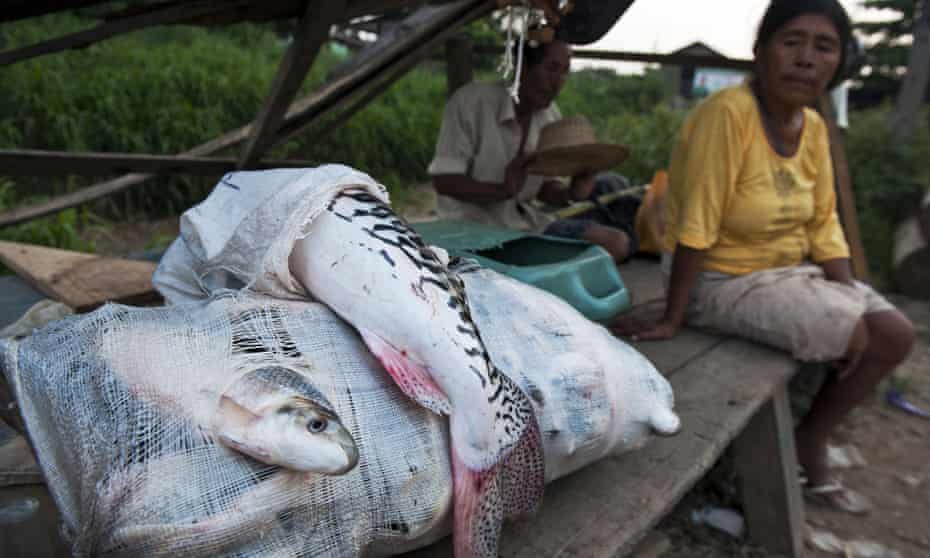
 Fish from the River Madre de Dios in Peru. Fish consumption is considered one of the two main ways mercury contamination has spread among local inhabitants - including those living upriver from gold-mining. Photograph: Cris Bouroncle

Ask about the fish in restaurants in the centre of Puerto Maldonado, the biggest town in Peru’s south-east Amazon, and you’ll hear all kinds of things. Some people will shake their heads and say there isn’t any fish on the menu “because of the contamination” or “out of protocol”. Others might say there is fish available, before sometimes hastily clarifying that it comes from farms along the Inter-Oceanica Highway running to Brazil, or from the Pacific coast, or even, according to one chef, all the way from Vietnam.

Why such problems with the fish in this part of the Amazon? Answer: alluvial gold and the mercury required to extract it. The gold-rush in the 8.5m hectare Madre de Dios region began in the 1980s and, by 2012, miners had destroyed more than 50,000 hectares of forest, effectively dumping 100s of tons of mercury into the rivers while doing so. In May this year Peru’s outgoing government announced a pathetic 60-day “declaration of emergency”.


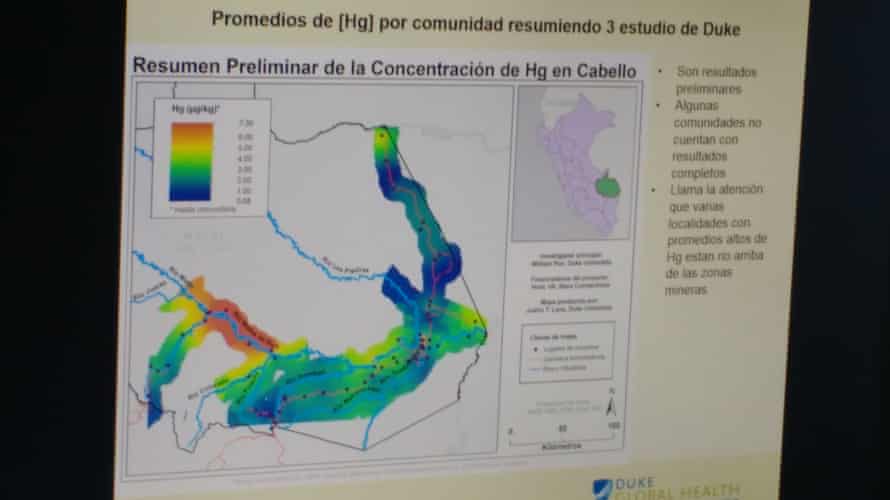
An image of a unpublished map obtained by the Guardian, based on “preliminary results” from studies of local inhabitants by the Duke Global Health Institute in the US, provides some idea of how widely-spread and severe the mercury contamination is across Madre de Dios. Arguably the map’s most alarming revelation is that the most contaminated area of all is upstream from the mining: the stretch of the River Madre de Dios between towns called Boca Colorado and Boca Manu, a significant part of which is in the buffer zone of the Manu national park, which Unesco calls the most biodiverse place on earth.

“It is noteworthy that some areas with high averages of mercury are upriver from the mining zones,” states the map, which was shown to Health Ministry officials earlier this year.

The map suggests the second worse-hit area is insidethe Manu park itself, immediately upriver from Boca Manu, along the River Manu’s left bank. The right bank is affected too. William Pan, the study’s lead researcher, told the Guardian “we didn’t sample people in Manu national park”, but explains the map on the basis that his teams have sampled several communities “along that bend of the river (Rio Manu/Rio Madre de Dios)” and “the map smoothing method creates a 10km buffer around the study sites and the exposure is extrapolated”.

According to US-based scientists, the people living upriver from gold-mining in Peru’s Madre de Dios region are the most contaminated by mercury. The worst-affected areas are shaded in red, the second-worst in orange, the third worst yellow. “µg/kg” should read “mg/kg.”
 According to US-based scientists, the people living upriver from gold-mining in Peru’s Madre de Dios region are the most contaminated by mercury. The worst-affected areas are shaded in red, the second-worst in orange, the third worst yellow. “µg/kg” should read “mg/kg.” Photograph: Anon.

How come people upstream are the most contaminated? Or maybe the mercury there has little or nothing to do with gold? As acknowledged by a 2011 report by the Environment Ministry, titled Gold-mining and Mercury Contamination in Madre de Dios: a Time-Bomb, mercury stored naturally in Amazon soil and vegetation is released when the forest is cut down or burnt and then leaches into the water.

as “very high” and says Madre de Dios is experiencing a “chronic mercury epidemic.” The contamination upstream was, he says, “the most surprising finding of our human Hg [mercury] assessment.”

“The communities near the confluence of Rio Manu and Rio Madre de Dios have the highest exposures in the region,” Pan told the Guardian. “When we tested fish, water and sediment, none of the values were high. So we were surprised when people were detected with high levels. We have several hypotheses that we are evaluating.”

According to Pan, those hypotheses are the people in that region migrate downriver to work in the mining, and that they are more dependent than the rest of Madre de Dios on local agriculture, fish and meat because there are no roads. Another is that “due to reliance on fish consumption, they are likely eat larger fish, which will have more Hg just naturally”.

Pan says the map was “supposed to be confidential with the Ministry of Health” because it is “unpublished data and we have not fully analysed all the samples,” calling it “very crude” and far from final. He told the Guardian it is based on three distinct studies conducted between May 2014 and June 2016, and the final results will include samples from almost 72 sites. He says the Health Ministry has “real monetary constraints right now due to expenditures of the prior ministry”.

Previous research by Pan and colleagues argued that mercury contamination is generating “significant health risks” for communities in Madre de Dios “hundreds of kilometres” downstream from the mining, particularly among children and indigenous people.

“Children living within the central portion of the [Madre de Dios] watershed cannot safely consume carnivorous fish without exceeding recommended international [mercury] body burdens,” stated an article by Pan et al in Environmental Science in January 2015. “Deforestation and mercury release are an immediate threat to both local and distant downstream communities, many of which do not benefit economically from [the mining].”

The law announcing Peru’s declaration of emergency in May stated that many people in Madre de Dios have “higher than the maximum recommended limits” of mercury, which causes “serious, chronic and complex health problems, particularly in children and pregnant women.”

“[M]ercury contamination of the air, water, sediment and fish is the result of inadequate practices by illegal and informal gold-miners during the extraction and working of alluvial gold,” the law stated. “In addition, there are people located beyond the mining extraction zones that are at high risk of being contaminated with mercury because of the high levels of it detected in the environment and in certain fish species, especiallyMota Punteada, which is part of the daily diet of Madre de Dios’s population.”

The social and environmental tragedy unfolding in Madre de Dios has been known about for many years: the Ministry of Environment dubbed it a “time-bomb” five years ago, but the bomb was ticking long before that. Will Peru’s new government, led by president Pedro Pablo Kuczynski, now take sincere, sustainable, non-violent steps to address the problem - not just in the Boca Manu region, obviously, but across Madre de Dios and Peru’s Amazon as a whole? What steps can the government take to initiate a massive public health campaign and inform those who are contaminated, or are at risk, and provide access to treatment – and if it doesn’t have the funds do so, who can provide them? What forms of alternative employment can be created, so those who find themselves forced to mine and handle mercury have other options? What steps can those buying, selling, hoarding, working and wearing Peruvian gold take to ensure they stop contributing to the devastation of huge swathes of the Amazon and the contamination of 1,000s of people living there?

The World Health Organization calls mercury “one of the top ten chemicals or groups of chemicals of major public health concern”, and states that human activity, including gold-mining and coal-fired power stations, is the “main cause of mercury releases.”

Peru is one of the world’s biggest gold producers, with the main importers being Canada, India, Switzerland, the UK and the US. A report published in April by the Global Initiative Against Transnational Organized Crime argued that 28% of all gold in Peru is illegal, with illegal gold-mining across Latin America increasingly controlled by drugs traffickers and “organized crime” groups.

In January Peru ratified the Minamata Convention on Mercury, a legally-binding global treaty which commits parties to regulate artisanal and small-scale mining, among other things, and states that “parties may cooperate with each other” to stop altogether the use of mercury or mercury compounds in such mining. Switzerland has ratified the Convention too, but not Canada, India or the UK.

Peru’s Health Ministry did not respond to questions