Mostrando entradas con la etiqueta mercurio. Mostrar todas las entradas

viernes, 11 de mayo de 2018

Cuatro regiones en Perú expuestas a contaminación por mercurio


Las personas que viven en las regiones de Madre de Dios, Huancavelica, Puno y Cusco tienen niveles de mercurio superiores a los que se consideran seguros.

Se estima que en los últimos 20 años, más de 3,000 toneladas de mercurio han sido arrojadas a los ríos en la Amazonía peruana.

Una publicación reciente confirmó que los habitantes de la población indígena nahua, ubicada en la comunidad de Santa Rosa de Serjali en la región peruana de Ucayali, tienen altos niveles de mercurio en la sangre. Esta información ha aumentado los temores sobre el impacto del uso del mercurio en la salud de las poblaciones más vulnerables, además del daño que podría causar en la tierra y la biodiversidad.

El informe fue publicado por el Ministerio de Salud del Perú y se titula "Análisis de la situación de salud de la comunidad nahua de Santa Rosa de Serjali en la reserva territorial de Kugapakori, Nahua, Nanti y otros grupos". Según una historia publicada en The Guardian sobre el informe filtrado, de los 150 miembros de la comunidad nahua cuyos datos se analizaron, el 78 por ciento tenía altos niveles de mercurio en la sangre.

Los ríos en la región de Madre de Dios han sido contaminados por mercurio debido a la minería ilegal. Foto de Rhett Butler para Mongabay.

Los ríos en la región de Madre de Dios han sido contaminados por mercurio debido a la minería ilegal. Foto de Rhett Butler para Mongabay.

La comunidad nahua no es el único grupo afectado por el mercurio en el Perú. Se han detectado altas concentraciones de mercurio en las regiones de Madre de Dios, Huancavelica, Cusco y Puno. La contaminación comenzó con la explotación de las minas de mercurio en décadas pasadas, y continúa hoy en la forma de la minería ilegal e informal. Otra fuente de contaminación por mercurio en el Perú actual es el Proyecto de Gas de Camisea.

Mercurio en tierra peruana

Según otro informe, esta vez del Ministerio del Medio Ambiente en enero de 2017, "se estima que en los últimos 20 años, más de 3.000 toneladas de mercurio han sido arrojadas a los ríos amazónicos, contaminando el agua, los organismos acuáticos y el las poblaciones humanas que consumen el agua y el pescado. "El informe se titula" Conservación y uso sostenible de los ecosistemas para la provisión de servicios ecosistémicos ".

El mismo estudio indica que, "en los últimos 18 años, las operaciones de oro en la región de Madre de Dios han deforestado aproximadamente 30,000 hectáreas de bosque tropical, principalmente en las cuencas de Huepetuhe y Caychive".

La minería tradicional en Perú no es un fenómeno reciente, según el estudio, sino más bien una actividad ancestral que ha estado ganando impulso desde finales de los años setenta. El informe agrega que el alto precio del oro ha llevado a la explotación de los depósitos de oro.

Un estudio del Instituto Carnegie reveló que los peces en los ríos de Madre de Dios tienen niveles de mercurio que superan las cantidades permitidas.

Un estudio del Instituto Carnegie reveló que los peces en los ríos de Madre de Dios tienen niveles de mercurio que superan las cantidades permitidas.

Inicialmente, la minería de oro informal en Perú se concentró en Madre de Dios, Puno, Sur Medio y La Libertad como un medio de subsistencia en minas abandonadas, dice el informe. Sin embargo, a mediados de la década pasada, la minería informal e ilegal se expandió por todo el Perú. En 2013, según el estudio del Ministerio de Medio Ambiente, esta actividad estuvo presente en 25 regiones del país.

Madre de Dios: un caso grave

Francisco Román es el director científico del Centro de Innovación Científica Amazónica (CINCIA), que fue creado por la Universidad Wake Forest y tiene su sede en Puerto Maldonado, Perú. Román dice que actualmente, los casos con los niveles más altos de contaminación por mercurio se encuentran en varios distritos en Madre de Dios y en La Rinconada, en la Región Puno. "Son lugares emblemáticos que reportan altos niveles de mercurio en los ecosistemas, así como en los seres humanos", dijo Román.

En una entrevista con Mongabay Latam, Román explicó que la CINCIA está llevando a cabo un estudio sobre la presencia de mercurio en Madre de Dios. "Estamos analizando los niveles de contaminación mediante un estudio integral que incluye la tierra, el agua, las plantas, los peces, [y] el aire. Pero también estamos desarrollando proyectos de remediación y reforestación en las áreas degradadas. Este es un hito muy importante en este campo de investigación porque, además de cubrir varias bases, tiene un rango geográfico más amplio que cualquier otro estudio realizado hasta este momento ", dijo Román.

Román también dijo que el estudio incluye estaciones de monitoreo en cada distrito que tiene actividad minera en la región. Estos distritos son Tambopata, Laberinto, Inambari, Huepetuhe, Madre de Dios y Camanti, que es parte de la Región Cusco pero comparte frontera con la Región Madre de Dios. "Estamos en los seis distritos de la Cuenca Madre de Dios donde se produce la minería", dijo Román.

El Centro de Innovación Científica Amazónica (CINCIA), con sede en Puerto Maldonado, está llevando a cabo una investigación exhaustiva sobre la contaminación por mercurio en Madre de Dios.

El Centro de Innovación Científica Amazónica (CINCIA), con sede en Puerto Maldonado, está llevando a cabo una investigación exhaustiva sobre la contaminación por mercurio en Madre de Dios. Foto cortesía del Centro de Innovación Científica Amazónica. Uno de los objetivos de la investigación, según Román, es identificar dónde comenzó la contaminación por mercurio y luego determinar cómo pasa el mercurio a través de la cadena alimentaria. "Se supone que hay mercurio que se evapora y, como gas, vuelve a caer sobre las plantas, la tierra o los cuerpos de agua", dijo Román. Ramón también dijo que en algunos casos, el mercurio se vierte directamente en los ríos. Luego recorre la cadena alimenticia a través de peces que luego son comidos por humanos. "El consumo de pescado es una fuente de contaminación por mercurio", agregó. Por otro lado, Román dijo que la investigación también permitirá a los investigadores comprender la distribución actual del mercurio en Madre de Dios. Usando bases de datos científicas, también descubrirán qué áreas están más peligrosamente contaminadas. Estudios previos demuestran los efectos del mercurio en las comunidades y ciudades indígenas de Madre de Dios. El estudio "Concentraciones de mercurio en peces y humanos en Puerto Maldonado", realizado por el Proyecto Carnegie Amazon Mercury (CAMEP) en 2013, encontró niveles elevados de mercurio en todas las comunidades analizadas en Madre de Dios. Más del 75 por ciento de las personas evaluadas tenían niveles de mercurio superiores a los permitidos. Según el estudio, los niveles de mercurio fueron más altos en las comunidades rurales e indígenas. En estos casos, el 95 por ciento de las personas evaluadas dijeron que consumían pescado capturado en los ecosistemas acuáticos locales. El estudio también reveló que el 78 por ciento de los 226 adultos analizados en Puerto Maldonado presentaba el triple del valor permitido de mercurio (un ppm), y una persona incluso llegaba a 27 veces eso. De las 15 especies de peces analizados, nueve tenían niveles de mercurio superiores a los estándares nacionales. Investigadores del Centro de Innovación Científica de la Amazonía toman muestras de los ríos. Foto cortesía del Centro de Innovación Científica de la Amazonía. Investigadores del Centro de Innovación Científica de la Amazonía toman muestras de los ríos. Foto cortesía del Centro para la Innovación Científica Amazónica. La situación es tan crítica en Madre de Dios que la administración del ex presidente Ollanta Humala fue forzada a declarar una emergencia en 11 distritos de la región. Esto se produjo después de que el Instituto Nacional de Defensa Civil presentara un informe que revelara los altos niveles de mercurio en sangre en la población del área. En ese momento, los distritos de Tambopata, Inambari, Las Piedras y Laberinto (en la provincia de Tambopata), Fitzcarrald, Manú, Madre de Dios y Huepetuhe (en la provincia de Manú) e Iñapari, Iberia y Tahuamanu (en la provincia de Tahuamanu) se encontraban en estado de emergencia durante 60 días. En agosto del mismo año, se amplió el estado de emergencia por otros 60 días. Mongotabay Latam inició una comunicación con el Ministerio de Medio Ambiente y el Ministerio de Salud para conocer qué medidas se están tomando para ayudar a las áreas afectadas por la contaminación por mercurio, así como aprender lo que se está haciendo con las poblaciones afectadas. En el momento de la publicación, todavía no había habido una respuesta. Hualcavelica: Contaminación históricaAlicia Abanto, una diputada de Medio Ambiente, Servicio Público y Comunidades Indígenas dentro de la Oficina del Defensor Público de Perú, dijo que Huancavelica es otra región que tiene altos niveles de contaminación por mercurio. "En esta región fue la mayor mina de mercurio en el Perú. Debido a eso, Huancavelica es uno de los pasivos ambientales más grandes para la explotación de mercurio que se desarrolló durante la época colonial. Todavía hay áreas en la ciudad de Huancavelica donde las comunidades y los barrios se han asentado en tierras contaminadas por mercurio, y aquellos que viven en esos lugares respiran los vapores de mercurio que emanan de la tierra todos los días ", dijo Abanto. Según un informe de El Defensor Público de la Dirección General de Salud Ambiental y Desocupación Ambiental, dentro del Ministerio de Salud de Perú, la contaminación en la ciudad de Huancavelica empeora debido a los materiales de la vivienda. Aproximadamente la mitad de las casas están hechas de adobe o mudwall, que están contaminadas porque provienen de tierras locales. La Mina Santa Bárbara, también conocida como la Mina de la Muerte, fue el epicentro de la extracción de mercurio durante la época colonial en el Perú. La mina Santa Bárbara, también conocida como la Mina de la Muerte, fue el epicentro de la extracción de mercurio durante la época colonial en Perú. Un estudio realizado por el Consejo de Salud Ambiental (COEH), una organización científica estadounidense dedicada a identificar, evaluar y remediar los efectos de las toxinas ambientales en el afecto comunidades, señala que "el 75 por ciento de los casos evaluados tienen niveles de mercurio superiores a los valores permitidos para la salud humana, en las paredes, en el suelo y en el aire interior, con un estimado de 19,000 personas con riesgo de efectos adversos para la salud aunque la exposición a [mercurio]. "El estudio también reveló que durante un período de cientos de años, la ciudad de Huancavelica y las áreas circundantes fueron contaminadas por un estimado de 20,000 toneladas métricas de vapor de mercurio. La mayoría del vapor se produjo durante el período colonial y se utilizó durante el proceso de refinación de la plata. En otro documento, el Abanto también dijo que la Dirección General de Asuntos Mineros Ambientales, en el Ministerio de Energía y Minas, ha identificado 160 sitios contaminados por minería en la región. En Huancavelica, se ha confirmado que existe contaminación por mercurio, dijo Abanto, debido a las medidas que se han tomado dentro de la población. Las personas están expuestas al mercurio en sus hogares y en las vías públicas sin pavimentar. "Las familias están respirando vapor de mercurio, pero no se están tomando medidas para protegerlas", dijo Abanto. Como un remedio para el problema, Abanto propone que las paredes de los edificios construidos con adobe o mudwall estén cubiertos con cemento, y dice que lo mismo debe hacerse para los pisos de estos edificios. Además, sugiere pavimentar las calles para reducir los vapores de mercurio que emanan. "Hay estudios que dicen que con estas medidas, la exposición al mercurio se ve disminuida en un 40 por ciento. Sin embargo, estas son familias muy pobres que a menudo no pueden realizar estas inversiones, por lo que se necesita la intervención del estado ", dijo Abanto. Ya se han dado una serie de recomendaciones a instituciones relevantes, tales como los ministerios de Salud, Medio Ambiente, Vivienda, Construcción y Saneamiento, Energía y Minas, y al gobierno regional de Huancavelica, entre otros. Parque Nacional del Manú y La Rinconada En un informe sobre los Pueblos Indígenas en Aislamiento y Contacto Inicial (PIACI), Mongabay Latam dijo que los habitantes de la reserva territorial Kugapakori, Nahua, Nanti y otros grupos, en Cusco, también han estado expuestos al mercurio. Estas comunidades también corren el riesgo de enfermedades como la tuberculosis, la hepatitis B, la malnutrición crónica, la sífilis, la anemia, las infecciones respiratorias agudas y las enfermedades diarreicas agudas. En estas comunidades, el 61.5 por ciento de la población evaluada excede el límite permitido de mercurio, según un informe de junio de 2017 del Defensor Público. Un estudio realizado en la comunidad de Maizal dentro de la población indígena Machiguenga reveló que todos sus habitantes tenían altos niveles de mercurio . Foto de Thomas J. Müller. Un estudio realizado en la comunidad de Maizal dentro de la población indígena Machiguenga reveló que todos sus habitantes tenían altos niveles de mercurio. Foto de Thomas J. Müller. En otra historia de Mongabay Latam sobre la comunidad Machiguenga ubicada dentro del Parque Nacional Manú en Cusco, se describió un estudio de 2014 del CAMEP. El estudio reveló que las 65 personas evaluadas en la comunidad de Maizal -una población indígena en la etapa de contacto inicial- dieron positivo en la prueba de contaminación por mercurio. Solo tres niños estaban por debajo del nivel de tolerancia biológica indicado por la Organización Mundial de la Salud (OMS). Estas personas tenían altos niveles de mercurio a pesar del hecho de que la minería ilegal está lejos de Manú; toma un día de viaje en un bote rápido en el río Madre de Dios para llegar allí. El documento "Conservación y uso sostenible de los ecosistemas para la provisión de servicios ecosistémicos", por el Ministerio de Medio Ambiente, también analiza el problema de la contaminación por mercurio en La Rinconada, que se encuentra en el distrito de Ananea, y en el lago Titicaca. "Los estudios científicos sobre el mercurio en peces, aguas superficiales y sedimentos en la cuenca del río Ramis y el lago Titicaca, desarrollados entre 2001 y 2003, demuestran altas concentraciones de mercurio en varias especies (Pejerrey peruano [Odontesthes regia] y cachorrito amarillo [Orestias luteus]) que habitan en estas aguas ", señala el documento. En el lago Titicaca, en Puno, peces como el pejerrey peruano y el cachorrito amarillo también se han encontrado con altos niveles de mercurio. Foto cortesía del Ministerio de Medio Ambiente. En el lago Titicaca, en Puno, peces como el pejerrey peruano y el cachorrito amarillo también tienen altos niveles de mercurio. Foto cortesía del Ministerio de Medio Ambiente. El documento también informa sobre la contaminación de tierras, aguas superficiales y sedimentos cerca del complejo minero La Rinconada y las áreas circundantes. Román, de la CINCIA, dice que hay tecnologías alternativas para la extracción de oro que hacen no involucrar mercurio. Él explica que en Madre de Dios, algunos mineros que buscan aprobación están empezando a usar tablas gravimétricas, que son sistemas que separan el oro mediante un proceso de vibración magnética. "Este método exige una mayor inversión inicial, y no todos están listos para hacer "El problema de la contaminación por mercurio en Perú se extendió desde la época colonial hasta el presente y se ha extendido a más lugares del país en las últimas décadas", dijo Román. A pesar de todos los estudios y datos preocupantes que se han presentado, los expertos consultados por Mongabay Latam coinciden en que hasta ahora se ha hecho muy poco para enfrentar el problema.

domingo, 1 de octubre de 2017

Mercury pollution watchdog to set up in Geneva

Geneva will play host to the body responsible for implementing a global convention to reduce mercury pollution. Some 150 countries voted in favour of the Swiss city at the first conference of the Minamata Convention on Mercury, which was also staged in Geneva.

The conference also agreed on a range of measures to limit the impact of mercury extraction and industrial usage. This included guidelines to regulate artisanal gold mining and the reduction of mercury emissions. Another guideline specifies how the atmospheric mercury emissions generated by coal-fired power plants, waste incineration plants and cement plants can be reduced.

Switzerland is an important legal trader in mercury and recycler. Switzerland exported 30 tonnes of mercury last year - down from 110 tonnes per year between 2011-2015 - the government said in June.

Geneva is a centre of expertise for hazardous chemicals and waste. It is already home to the secretariats for the Stockholm Convention on Persistent Organic Pollutants (POP), the Rotterdam Convention on the Prior Informed Consent Procedure for Certain Hazardous Chemicals and Pesticides in International Trade, and the Basel Convention on the Control of Transboundary Movements of Hazardous Wastes and Their Disposal.

On Saturday, at the end of a six-day conference, the Minamata Convention's secretariat was added to the list of agencies that Geneva will host.

Regulation changes

"The arrival of the Secretariat of the Minamata Convention will be a boost for Geneva as center of the international environment governance," said Marc Chardonnens, Director of the Federal Office for the Environment.

"The measures for reducing mercury emissions that pose a risk to health and the environment can begin," he added.

The Swiss government is expected to lay out its position by the end of the year on how to amend legislation to match the convention's objectives of reducing pollution. It will have to steer a line between environmental groups advocating a complete ban on mercury trading and the industry that is lobbying against strict regulation.

The Minamata Convention, named after a Japanese fishing town where mercury was discharged into the bay by a large chemical company between 1932 and 1968, entered into force on August 16, 2017. It was initiated by both Switzerland and Norway. So far, 79 states have ratified the convention, including the United States, China, Brazil, Indonesia, Peru and Switzerland (on May 26, 2016).

Mercury

Mercury is a highly toxic heavy metal considered by the World Health Organization to be one of the top ten chemicals of major public health concern.

The chemical element occurs naturally and can be released into the environment via the weathering of mercury-containing rocks, forest fires, volcanic eruptions or geothermal activities. But according to the United Nations, 90% of the 5,500-8,900 tons of mercury currently emitted or re-emitted each year to the atmosphere is man-made. It is released unintentionally from industrial processes such as coal-fired power stations, cement production, mining, waste incineration, and metallurgic activities.

Mercury is extensively used to extract gold from ore in artisanal and small-scale gold mining. It is contained in electrical switches, relays, measuring control equipment, fluorescent light bulbs, batteries and dental amalgam. Mercury is also used in laboratories, cosmetics, pharmaceuticals, vaccines, paints and jewellery.

jueves, 13 de julio de 2017

Mercury-Free Gold: How You Can Protect The Future By Buying This Ethical And Sustainable Jewellery

Gold mining’s association with poor health and environmental damage has been unearthed over the years - but it’s still something many of us know little about.

“People have heard about ‘blood diamonds’, but not many realise that their gold could be responsible for one of the world’s top toxic threats – mercury,” says Richard Fuller, the President of Pure Earth – a New York-based charity that helps to clean up pollution in the poorest communities in developing countries that are affected by toxins.

Mercury poisoning can cause many unpleasant symptoms including brain malfunction, slurred speech, memory loss and loss of balance.

Artisanal small-scale gold mining is the largest source of human-caused mercury pollution in the world (even more than the burning of fossil fuels), according to the International Development Research Centre (IDRC).

Gold has long been coveted. But as our lust for the material goes unabated the industry has been steeped in accusations of exploitation, child labour and poor wages.

In turn, artisanal and small-scale gold mining (ASGM) has attempted to provide an ethical overhaul by implementing hallmarks for Fairtrade and Fairmined gold to guarantee a more ethical process.

And now a spotlight has now fallen on mercury-free gold – and it’s jewellery designers who are helping to lead the way.

Miner in Burkina Faso mining for mercury-free gold.

One such designer is Kimberly McDonald, a fine jewellery designer based in New York City, US. From gemstones to diamonds and metals, she consistently demands traceability for every material she uses within a piece of jewellery.

“In this market it is no longer enough to have a beautiful one-of-a-kind product,” she told HuffPost UK.

“People want to feel comfortable with the knowledge that what they spend their money on does not come at a larger cost to the planet.

“As a brand, Kimberly McDonald could not knowingly produce pieces that originate from something that is destructive to the environment.

“We also have seen increasing interest from our clientele about how the materials we use are mined and where our pieces are manufactured.”

Gold mines are mainly situated in developing countries – such as Nigeria, Burkina Faso and Indonesia – and they can be a dangerous environment to work in.

Due to a lack of high-tech equipment available in artisanal and small-scale gold mining (ASGM), the danger here can be even higher due to the use of toxic chemicals like mercury to extract the gold.

Mercury use in Nigeria.

“The largest source of global mercury emissions comes from artisanal gold mining, which produces up to a quarter of the world’s gold,” said Fuller.

“Because mercury travels, it is everyone’s problem. From poor miners and their communities who are directly poisoned, to families eating contaminated fish living half a world away.

“But the good news is that we are all part of the solution.”

The detrimental effects of mercury on the human body can be extensive.

“We’ve learned a lot about how this mercury effects us and our children from reported exposures to mercury over the last 100 years,” wrote physician Mark Hyman, in a blog hosted on HuffPost in 2011, entitled ‘Mercury: How To Get This Lethal Poison Out Of Your Body’.

“The symptoms and diseases these exposures have caused are varied and mimic many other conditions. Nervous system toxicity can cause erethism (‘mad hatter syndrome’) with symptoms of shyness; laughing, crying, and dramatic mood swings for no apparent reason; nervousness, insomnia, memory problems, and the inability to concentrate.

And the list continues: “Other neurologic symptoms may include encephalopathy (non-specific brain malfunction), nerve damage, Parkinsonian symptoms, tremor, ataxia (loss of balance), impaired hearing, tunnel vision, dysarthria (slurred speech), headache, fatigue, impaired sexual function, and depression.”

An amalgam of mercury mixed with gold.

The process involved in using mercury to extract gold has been linked to causing health issues for miners. According to a report by The Artisanal Gold Council (AGC), 10 to 15 million people are directly involved with ASGM.

However, sourcing a strong statistic of how many people are truly involved in ASGM hasn’t been easy.

“Estimating the number is not a simple task because it is largely an informal or poorly understood economic sector - often with little government contact and occurring in many remote regions,” explains Dr Kevin Telmer, executive director of Canada’s Artisanal Gold Council - who work to improve the health, economy an environment in AGSM.

“ASGM is a big and important livelihood. It’s a 20 billion dollar primary economy.

“It is practiced directly by 10 million people and supports a population of 100 million people in more than 80 countries.

“Every time we have had the opportunity to look more closely and collect more robust information, the estimate has risen.

“This is not because there are necessarily more and more people involved but also because of better information and understanding.”

Due to a lack of high-tech equipment, miners may use a dangerous method for extraction: the process of amalgamation – which is when gold comes in contact with mercury and the two mix to form a compound called an amalgam.

After the gold dissolves into the mercury, small gold particles are left. During this process, the burning of mercury releases harmful chemicals into the air which are not only toxic for humans, but also the environment and wildlife.

But changes are being made for a safer process.

“The biggest development to change the practice of using mercury to mine gold is the Minamata Convention on mercury - a UN Environment treaty signed by the world’s governments,” explains Dr. Kevin Telmer.

“Under the Minamata Convention, countries have agreed to introduce mercury-free technology to assist artisanal and small-scale miners to use alternative and more profitable techniques.

“This serves the double purpose of eliminating mercury pollution while still providing what is broadly recognised by world bodies as an important livelihood supporting around 100 million poor people in more than 70 countries.”

Shaking table introduced by AGC in Burkina Faso to recover gold without the use of mercury.

But with consumers – specifically millennials - demanding change, some jewellery designers are already actively sourcing mercury-free gold.

Kimberly McDonald is not the only designer who shares that pioneering mindset.

Pamela Love, a fine jewellery designer from New York City, has visited Suriname in South America to meet with their government and policy makers – who are working to restructure their gold mining industry.

“In Suriname, there were medium scale mines and small scale artisanal mines who were working in the rainforest and releasing mercury into the environment,” explained Love.

“The goal was, and is, to move these artisanal miners out of the virgin rainforest and into areas that are zoned for gold mining.

“They also are working to educate small-scale miners on the dangers of mercury in gold mining, to their health, as well as to the rainforest, and provide them with alternative methods of mining that are safer for them, the environment and ultimately yield more gold.

“This type of education is so important to our health, and our planet’s health.”

Artisanal gold produced in Burkina Faso.

A jewellery manufacturer – who wishes to remain anonymous - explained to HuffPost UK the need for traceability – from mine to manufacturer.

“To ensure that we are actually using mercury-free gold, as a manufacturer, we use suppliers that are independently certified,” the manufacturer explained.

″We work with vendors that have received certifications from their suppliers, verifying that they only source and manufacture metals and alloys from ‘DRC-Conflict Free’ mines or other domestic U.S. Sources.

“Mercury-free techniques to recover gold are safer for miners, their families and local communities.

“Mercury-free may also help miners market their gold at higher prices as awareness and consumer requests grow. Many are becoming ‘Fairminded-Certified’.

“Being a small manufacturer, we source our raw materials (precious metals, diamonds and gemstones) from suppliers that are certified. Design, assembly and finishing are done at our facility.

“As jewellers it is important for us to use more sustainable and ethical materials as it not only protects the environment, but also has a positive impact on the communities and lives of workers.”

Artisanal small-scale gold mining provides families with an opportunity to escape poverty. To completely remove or halt the process would be ineffective.

What miners need is access to better technology and working conditions. It is possible to create beautiful pieces of jewellery in a way that isn’t harmful to our planet and people.

“With Pure Earth, the UN and other organisations are training artisanal miners to go mercury-free, and with consumers and the industry demanding mercury-free artisanal gold, we will begin to see a difference,” concluded Fuller.

sábado, 19 de noviembre de 2016

Leaked map reveals chronic mercury epidemic in Peru

Leaked map reveals chronic mercury epidemic in Peru

People living upriver from gold-mining are the most contaminated, according to US-based scientists

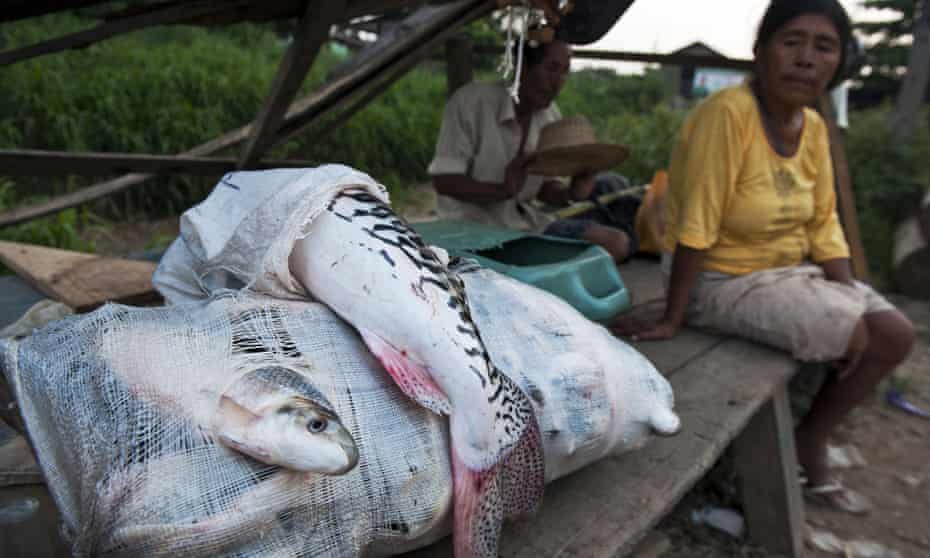
 Fish from the River Madre de Dios in Peru. Fish consumption is considered one of the two main ways mercury contamination has spread among local inhabitants - including those living upriver from gold-mining. Photograph: Cris Bouroncle

Ask about the fish in restaurants in the centre of Puerto Maldonado, the biggest town in Peru’s south-east Amazon, and you’ll hear all kinds of things. Some people will shake their heads and say there isn’t any fish on the menu “because of the contamination” or “out of protocol”. Others might say there is fish available, before sometimes hastily clarifying that it comes from farms along the Inter-Oceanica Highway running to Brazil, or from the Pacific coast, or even, according to one chef, all the way from Vietnam.

Why such problems with the fish in this part of the Amazon? Answer: alluvial gold and the mercury required to extract it. The gold-rush in the 8.5m hectare Madre de Dios region began in the 1980s and, by 2012, miners had destroyed more than 50,000 hectares of forest, effectively dumping 100s of tons of mercury into the rivers while doing so. In May this year Peru’s outgoing government announced a pathetic 60-day “declaration of emergency”.


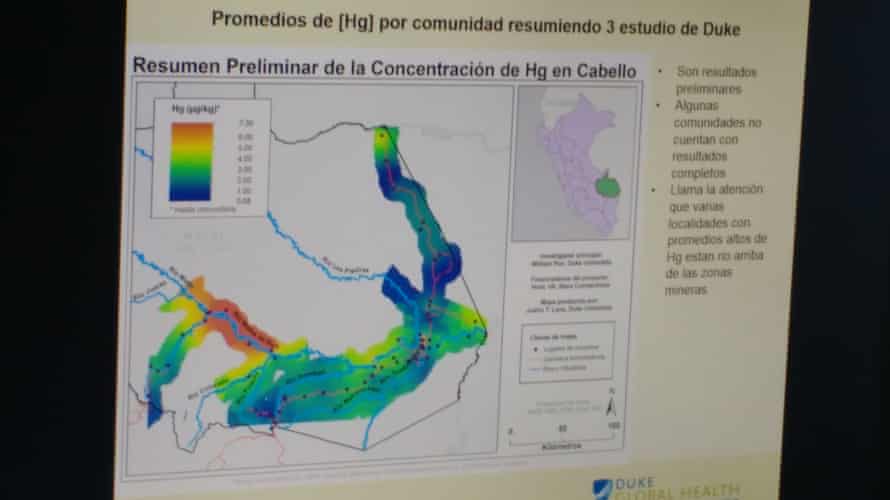
An image of a unpublished map obtained by the Guardian, based on “preliminary results” from studies of local inhabitants by the Duke Global Health Institute in the US, provides some idea of how widely-spread and severe the mercury contamination is across Madre de Dios. Arguably the map’s most alarming revelation is that the most contaminated area of all is upstream from the mining: the stretch of the River Madre de Dios between towns called Boca Colorado and Boca Manu, a significant part of which is in the buffer zone of the Manu national park, which Unesco calls the most biodiverse place on earth.

“It is noteworthy that some areas with high averages of mercury are upriver from the mining zones,” states the map, which was shown to Health Ministry officials earlier this year.

The map suggests the second worse-hit area is insidethe Manu park itself, immediately upriver from Boca Manu, along the River Manu’s left bank. The right bank is affected too. William Pan, the study’s lead researcher, told the Guardian “we didn’t sample people in Manu national park”, but explains the map on the basis that his teams have sampled several communities “along that bend of the river (Rio Manu/Rio Madre de Dios)” and “the map smoothing method creates a 10km buffer around the study sites and the exposure is extrapolated”.

According to US-based scientists, the people living upriver from gold-mining in Peru’s Madre de Dios region are the most contaminated by mercury. The worst-affected areas are shaded in red, the second-worst in orange, the third worst yellow. “µg/kg” should read “mg/kg.”
 According to US-based scientists, the people living upriver from gold-mining in Peru’s Madre de Dios region are the most contaminated by mercury. The worst-affected areas are shaded in red, the second-worst in orange, the third worst yellow. “µg/kg” should read “mg/kg.” Photograph: Anon.

How come people upstream are the most contaminated? Or maybe the mercury there has little or nothing to do with gold? As acknowledged by a 2011 report by the Environment Ministry, titled Gold-mining and Mercury Contamination in Madre de Dios: a Time-Bomb, mercury stored naturally in Amazon soil and vegetation is released when the forest is cut down or burnt and then leaches into the water.

as “very high” and says Madre de Dios is experiencing a “chronic mercury epidemic.” The contamination upstream was, he says, “the most surprising finding of our human Hg [mercury] assessment.”

“The communities near the confluence of Rio Manu and Rio Madre de Dios have the highest exposures in the region,” Pan told the Guardian. “When we tested fish, water and sediment, none of the values were high. So we were surprised when people were detected with high levels. We have several hypotheses that we are evaluating.”

According to Pan, those hypotheses are the people in that region migrate downriver to work in the mining, and that they are more dependent than the rest of Madre de Dios on local agriculture, fish and meat because there are no roads. Another is that “due to reliance on fish consumption, they are likely eat larger fish, which will have more Hg just naturally”.

Pan says the map was “supposed to be confidential with the Ministry of Health” because it is “unpublished data and we have not fully analysed all the samples,” calling it “very crude” and far from final. He told the Guardian it is based on three distinct studies conducted between May 2014 and June 2016, and the final results will include samples from almost 72 sites. He says the Health Ministry has “real monetary constraints right now due to expenditures of the prior ministry”.

Previous research by Pan and colleagues argued that mercury contamination is generating “significant health risks” for communities in Madre de Dios “hundreds of kilometres” downstream from the mining, particularly among children and indigenous people.

“Children living within the central portion of the [Madre de Dios] watershed cannot safely consume carnivorous fish without exceeding recommended international [mercury] body burdens,” stated an article by Pan et al in Environmental Science in January 2015. “Deforestation and mercury release are an immediate threat to both local and distant downstream communities, many of which do not benefit economically from [the mining].”

The law announcing Peru’s declaration of emergency in May stated that many people in Madre de Dios have “higher than the maximum recommended limits” of mercury, which causes “serious, chronic and complex health problems, particularly in children and pregnant women.”

“[M]ercury contamination of the air, water, sediment and fish is the result of inadequate practices by illegal and informal gold-miners during the extraction and working of alluvial gold,” the law stated. “In addition, there are people located beyond the mining extraction zones that are at high risk of being contaminated with mercury because of the high levels of it detected in the environment and in certain fish species, especiallyMota Punteada, which is part of the daily diet of Madre de Dios’s population.”

The social and environmental tragedy unfolding in Madre de Dios has been known about for many years: the Ministry of Environment dubbed it a “time-bomb” five years ago, but the bomb was ticking long before that. Will Peru’s new government, led by president Pedro Pablo Kuczynski, now take sincere, sustainable, non-violent steps to address the problem - not just in the Boca Manu region, obviously, but across Madre de Dios and Peru’s Amazon as a whole? What steps can the government take to initiate a massive public health campaign and inform those who are contaminated, or are at risk, and provide access to treatment – and if it doesn’t have the funds do so, who can provide them? What forms of alternative employment can be created, so those who find themselves forced to mine and handle mercury have other options? What steps can those buying, selling, hoarding, working and wearing Peruvian gold take to ensure they stop contributing to the devastation of huge swathes of the Amazon and the contamination of 1,000s of people living there?

The World Health Organization calls mercury “one of the top ten chemicals or groups of chemicals of major public health concern”, and states that human activity, including gold-mining and coal-fired power stations, is the “main cause of mercury releases.”

Peru is one of the world’s biggest gold producers, with the main importers being Canada, India, Switzerland, the UK and the US. A report published in April by the Global Initiative Against Transnational Organized Crime argued that 28% of all gold in Peru is illegal, with illegal gold-mining across Latin America increasingly controlled by drugs traffickers and “organized crime” groups.

In January Peru ratified the Minamata Convention on Mercury, a legally-binding global treaty which commits parties to regulate artisanal and small-scale mining, among other things, and states that “parties may cooperate with each other” to stop altogether the use of mercury or mercury compounds in such mining. Switzerland has ratified the Convention too, but not Canada, India or the UK.

Peru’s Health Ministry did not respond to questions


martes, 1 de abril de 2014

Porque ocurre la especulación de precios del cianuro y mercurio 2014


La erradicación de la minería ilegal es importante para detener el mal uso de los insumos químicos como el cianuro y mercurio que le dan los mineros informales que sin tener conocimientos mínimos de química básica, seguridad e higiene hacen mal uso de estos insumos en desmedro de su propia salud y el medio ambiente, produciendo enfermedades y muerte de personas que habitan en las inmediaciones de estos campamentos mineros, contaminación de los ríos (flora y fauna local).
Ante esto sean tomado medidas que aun son desconocidas por estas personas dedicadas a esta labor. Apoyemos esta cruzada. Necesitamos mineros registrados, capacitados e informados.